Dentistry just overtook medicine. It’s now the harder application.
For years, medicine was the benchmark. Not anymore. Medicine sits at a 16% offer rate. Dentistry is now at 15%. Dentistry applicants are competing in the harder market, and most of them don’t know it yet.
And almost everything available to help them was built for medicine. The coaching programmes, the personal statement guides, the interview prep. Dentistry gets a slightly edited version and the hope that it transfers.
It doesn’t. Dental schools have their own requirements, their own interview formats, their own expectations. The wrong preparation costs you an offer.
Dr Ash holds both a medical degree and a dental degree from King’s College London, ranked number one in the world when he applied. He developed the same method now taught through the Predictable Offer Protocol™. Your Dedicated Coach™ understands how dentistry applications differ from medicine, and builds your strategy around that from the start. 93% of our students get at least one offer.
The dentistry applicant’s blind spot
Search for help with a dental school application and almost everything you find is aimed at medicine. You either adapt it and hope for the best, or you find a service that claims to cover dentistry but hands you the same material in a different wrapper.
Dental schools are looking for something different. How you frame your clinical exposure, how you structure your personal statement, which universities you target and why, how you prepare for interview. All of it diverges from medicine in ways that cost offers.
Dentistry is now statistically the harder application. You cannot afford the wrong preparation.
Time
Medicine and dentistry applicants face the same brutal timeline. But dental applicants also need to navigate unique requirements on top of everything else: dental-specific work experience, understanding of the career beyond what medicine applicants prepare for, and universities that weight things differently. The same amount of time, with more to get right.
Making mistakes
Most dentistry applicants make mistakes they never see coming, because the frameworks they are using were built for medicine. The personal statement emphasis is wrong. The interview preparation focuses on the wrong things. The work experience reflection misses what dental schools actually care about. These are not small errors. They are the difference between an offer and a rejection.
Overwhelmed
Medicine applicants at least have an industry built around them. Dentistry applicants get a fraction of the guidance. Fewer dental-specific resources, fewer people who have been through it, fewer places to turn when you are unsure whether what you are doing is right. The information gap makes the whole process feel harder than it needs to be.
All Eyes on You
“I couldn’t even get into dentistry.” That is what people around you will think, because most people assume dentistry is easier than medicine. It is not. It is statistically harder. But that perception makes the stakes feel even higher, and the fear of not getting in becomes something you carry silently.
Don’t know what good looks like
What does a strong dental school personal statement actually look like? What do dental school interviewers really want to hear? What UCAT score do you actually need for the dental schools on your list? There are almost no dental-specific benchmarks available publicly. You are preparing in the dark, and you have no way of knowing whether your application is strong until it is too late.
One coach. One system. Everything connected.
Most applicants treat the application as a series of separate hurdles: the UCAT, personal statement, work experience, university selection, and interviews. They try to solve each one independently. This creates a fragmented approach where the pieces never add up to more than the sum of their parts, and families are left feeling overwhelmed, uncertain, and unsure whether they’re even on the right track.
Future Doc works differently. A dedicated coach who knows your complete profile coordinates every element of your application as one interconnected system. Every decision is made with the full picture in mind.
The result: 93% of our students receive at least one offer. If they don’t, they continue into the following application cycle for free.

Built for dental school. Not borrowed from medicine.
Dentistry is a core discipline woven throughout the entire Predictable Offer Protocol. It is not a bolt-on. It is not an adaptation. Every element has been built with dental school admissions as a first-class consideration from the start.
Dedicated Coach™
Your coach is selected because they have genuine dental admissions expertise. They are not a medicine coach adapting on the fly. They know how dental schools differ from medical schools, and that knowledge shapes every decision from your first session. The coach is selected for your route, not briefed on it afterwards. That's the Dedicated Coach →
Impact Statement™
Your personal statement needs to demonstrate clinical curiosity, manual dexterity, and an understanding of the patient relationship in a dental context. The Impact Statement, our personal statement methodology, ensures your statement is written for dental school admissions panels, not borrowed from a medicine template. Dental schools look for different things in how you frame your motivation, your clinical exposure, and your understanding of what the career actually involves. That's the Impact Statement →
University Selection Clinic™
The dental school landscape is a different picture to medicine. UCAT thresholds, interview formats, offer rates, and how they weight different parts of the application all diverge. The University Selection Clinic, where your coach maps your profile against every dental school, ensures your four choices are data-driven and deeply personal. Getting this wrong with dentistry is particularly costly because there are fewer dental schools to choose from. That's the University Selection Clinic →
UCATalyst Method™
The UCAT still applies to most dental schools, but dental-specific university targets change the score strategy. A score of 2250 opens different doors on the dental side than on the medical side. The UCATalyst Method, our structured UCAT preparation system, calibrates your target score to the dental schools that best fit your full profile, not just the ones that appear on a generic list. That's the UCATalyst Method →
Think Like a Doctor™
Dental school interviews test a different emphasis. MMI stations, panel formats, and the balance of clinical versus ethical questioning all vary from what medicine applicants face. Think Like a Doctor, our interview preparation module, gives you university-specific practice for the formats used by the dental schools on your list, not generic healthcare interview prep with dental questions added on. That's Think Like a Doctor →
These are five of the twelve elements within the Predictable Offer Protocol. Every element adapts to dentistry as a core discipline.
See How Everything ConnectsDesigned by someone who holds both a medical and a dental degree.
Most coaching programmes cover dentistry as an afterthought. A sentence on the website. A tick box during sign-up. The same coaches, the same materials, the same advice, with "dentistry" swapped in where "medicine" used to be.
Dr Ash holds a dental degree from King’s College London. He built the Predictable Offer Protocol with dentistry as a first-class discipline from the very beginning, not a variation bolted on after the fact. The coaches who work with dental applicants know dental admissions. They are selected for that expertise.
The question families often ask is: “Can’t I just use a medicine programme and adapt it?” That is exactly the problem most dental applicants face. They use resources built for medicine and hope the differences are small enough not to matter. They are not. Dental schools look for different things in your personal statement, weight different parts of the application, use different interview formats, and have their own UCAT thresholds. Getting any of those wrong costs you an offer in a market where only 15% of applicants get one.
Dentistry is not an afterthought at Future Doc. It is woven into every element, every coaching session, and every decision your coach makes about your application.
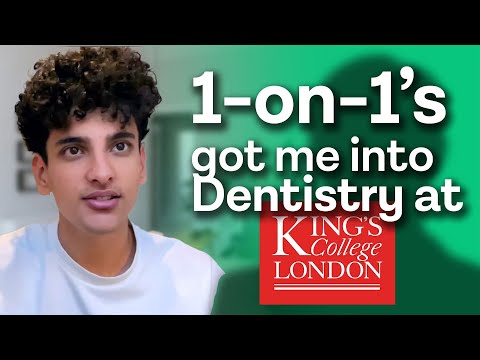
“Although I was one of the best in my classes, what I quickly found out was that grades are only a very small percentage of what it takes to succeed. Having my own personalised coach who really became a companion throughout the entire process was one of the best decisions I have made.”Dara, UG Dentistry

The Future Doc Guarantee
The Offer Guarantee
If you complete the programme, attend your sessions, and follow the roadmap your coach sets out for you, and you still don't receive an offer from any medical or dental school, we continue working with you into the following application cycle at no extra cost. We re-strategise and pick up right where you left off.
30-Day Money-Back Guarantee
Try the programme with complete confidence. If for any reason you're not happy within the first 30 days, we'll give you a full refund. No questions asked.
— Dr Ash
93% of Future Doc students receive at least one offer to medical or dental school.
Frequently asked questions
Is the programme really built for dentistry, or is it adapted from medicine?
Built for it. Dr Ash holds both a medical degree and a dental degree from King’s College London. Dentistry is a core discipline woven throughout the entire Predictable Offer Protocol, not a variation of the medicine programme. Every element, from personal statement preparation through the Impact Statement to interview practice through Think Like a Doctor, has been designed with dental school admissions as a first-class consideration.
Your coach is selected because they have genuine dental admissions expertise, not because they have been given a briefing document on how dentistry differs from medicine. The distinction matters. A programme that starts with medicine and adds a dental layer will always miss the nuances. A programme that treats dentistry as a core discipline from the outset does not have that problem.
Do dental schools use the UCAT differently?
Yes. Dental schools have their own UCAT thresholds, and they often weight the score differently in their overall admissions process. A score that would be considered strong for certain medical schools may not be strong enough for the dental schools you are targeting, and vice versa. The landscape is different.
Through the UCATalyst Method, your coach calibrates your UCAT preparation to the dental schools that best fit your full profile, working in tandem with the University Selection Clinic. Your target score is not a generic number. It is based on the specific dental schools where you have the strongest chance of an offer, taking into account how each one uses the UCAT alongside grades, personal statement, and interview performance.
How is the personal statement different for dental schools?
Dental school admissions panels are looking for something specific. Clinical curiosity framed around dental procedures and patient care, an understanding of manual dexterity and why it matters, and a genuine grasp of what the career involves beyond what most applicants write. A medicine personal statement that swaps in the word “dentistry” will not do it.
Through the Impact Statement, your coach helps you build a personal statement that reflects the dental profession authentically. How you frame your work experience, what you choose to reflect on, and how you demonstrate your understanding of patient relationships in a dental context all need to be calibrated for dental admissions panels specifically. Your personal statement also sets up your interview, so what you write and how you write it has consequences well beyond the initial application.
What dental school interview formats should I prepare for?
Dental schools use a range of formats including MMIs, panel interviews, and hybrid approaches. The balance of clinical, ethical, and motivational questioning differs from medicine interviews, and each dental school has its own emphasis. Preparing for a generic healthcare interview and hoping it covers dentistry is how applicants get caught out.
Through Think Like a Doctor, your coach prepares you for the specific formats used by the dental schools on your list. This includes university-specific practice, where we simulate the pressure of the real interview environment, so you walk in having already experienced something very close to what you will face. The near-100% interview conversion rate our students achieve is not just because of the interview preparation itself, but because of all the work that has gone into the application before that point.
When should I start preparing for dental school applications?
The sooner you start, the stronger your application. Students who begin early have more time for each element to compound: work experience reflection becomes deeper, UCAT preparation can follow the full structured approach, and the personal statement goes through more meaningful refinement. The early stages are light, so starting sooner does not mean doing more. It means doing everything better.
That said, the Predictable Offer Protocol is designed to adapt to wherever you are in the process. If you are coming in later, your coach adjusts the plan to your timeline. Starting later does not mean you cannot do well. It means the plan looks different. The important thing is that you are not preparing alone, using the wrong resources, or guessing at what dental schools actually want.
What happens if I don’t get an offer?
If you complete the programme, attend your sessions, and follow the roadmap your coach sets out, and you still don’t receive an offer, we continue working with you into the following application cycle for free. We don’t just want you on the programme. We want you to get in. We back our students all the way, because that's what we're here to do.
For the 7% of our students where the outcome does not go their way in a given cycle, the result does not define their ability. Some of the best doctors and dentists failed to get in the first time. What matters is that you have a team around you who will not let you give up, who will help you understand what happened, and who will make sure the next application is even stronger. Many students who continue into the following application cycle go on to receive multiple offers, which is a nice problem to have, because your coach then helps you choose the right university for your career trajectory.
Dentistry is the harder application. Make sure your preparation matches.
93% of our students receive at least one offer. The national dentistry offer rate is 15%.
Apply to the ProgrammeWe purposefully limit capacity to ensure quality