
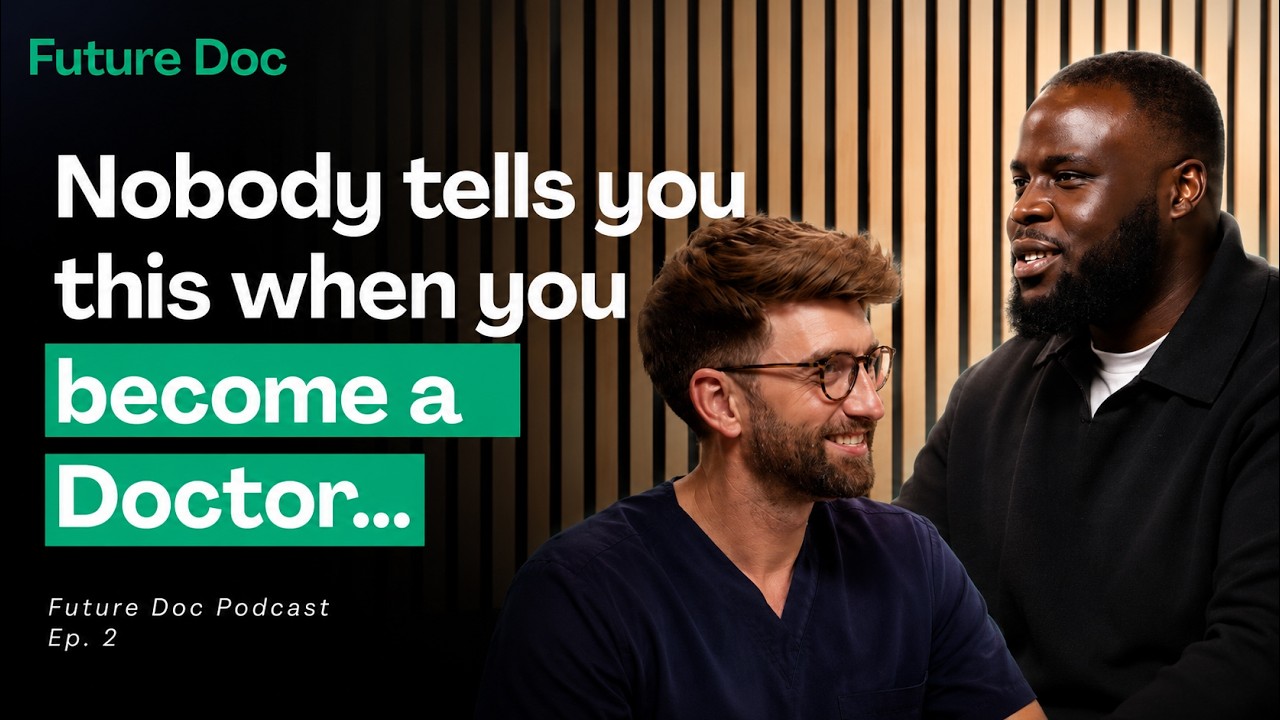
From the Future Doc YouTube channel · Recorded 6 September 2026 · 34 min video
Being an FY1 doctor is fast, chaotic and exhausting at first, especially if you start on a busy job like general surgery, but within a few weeks you settle in and start to enjoy it. You are a baby doctor: nobody expects you to know everything, they expect you to work safely and escalate when you need to. Medical school prepares you for day one, and the job teaches you everything after that.
Key takeaways
- Your first weeks as an F1 will feel like a baptism of fire. That is normal, and you upskill very quickly.
- Take a break, even on your first day. There are very few things that can’t wait 10 minutes while you grab a sandwich and a coffee.
- Jobs generate more jobs, so you will never colour in the whole list. Hand over safely to the night team and leave work at the door.
- Your UCAT score stops mattering once you’re in, but the skills from work experience, reflection and interviews carry forward into your whole career.
- Give your application at least a year of planning, ideally longer, so you aren’t rushing and stressing at the end.
What’s changed since this video
This video was recorded in September 2026. Most of the advice still stands, but note:
- From 2026 entry, UCAS replaced the free-text personal statement with three structured questions, with 4,000 characters across all three. The advice on reflecting on experience still applies, but it now goes into those three answers.
What is your first day as an FY1 doctor like?
On our podcast I sat down with Adewale, one of our coaches, the day after he finished his first year working as a doctor. I asked him what his very first day felt like. His answer: chaos, nerves and a lot of anxious energy.
He started on general surgery, which is exactly where I started too. For anyone who doesn’t know, the acute general surgery ward looks after people who come in needing life-saving surgery, usually something abdominal. His first day was a post take day, where you review all the patients admitted overnight with your consultant.
Surgical ward rounds are not like medical ward rounds. You’re in and you’re out. Adewale was carrying a laptop in one arm, typing with the other, pen in his scrub pocket, water bottle in hand, trying to keep up with surgeons bolting back and forth. The water bottle had to go. His job was to catch every plan and make sure the right patients were nil by mouth for surgery, because you look like an absolute idiot if they’re not.
His dad had packed him the nicest lunch. He planned to eat it at 1 p.m. He didn’t touch it until five. It was also his birthday.
I had my own version of this. On one of my first ward rounds I still had my medical school hat on: introduce yourself, be kind, take your time. A patient asked me to pass her something from the table, and I stopped for maybe 30 seconds to help. The registrar pulled me aside and said, “Mate, we’re already on the final patient of this bay.” They’d moved on three patients without me.
Being kind to patients always matters. But when it’s serious, life-saving surgery, the kind thing is getting the job done well and efficiently. In a busy district general hospital, the registrar and consultant may need to be in theatre in 15 or 20 minutes. The ward round is the small window they have to see everyone before they’re gone for the day.
Why the first few weeks of F1 feel so exhausting
I described it to Adewale as a Karate Kid moment. At medical school you learn the knowledge, the skills and the techniques. Then, especially in an intense first job, you suddenly have to put all of it into practice, fast. I remember being knackered for the first two weeks because you learn so much so quickly.
He said the same. He was sleeping every day after work and skipping work socials. On surgery you’re in at 7.30 to prep patients for the ward round at eight, and from eight until five you’re looking after those patients and doing the jobs.
And here’s the thing nobody tells you: jobs generate more jobs. Adewale’s example was a patient who needed an MRI of the pancreas. The scan shows a gallstone stuck in the common bile duct. Now they need surgery. Now there’s a whole new set of tasks.
His big lesson from those first weeks was that you will never finish the list. You have to hand over safely to the dedicated night team and leave it at the door, rather than believing you have to do everything yourself in one shift. That’s simply impossible.
I actually think this is one of the underrated parts of working as a doctor. When you’re there, it’s intense. But with good systems in place, which almost every hospital has, you can switch off when you go home. That isn’t true of every job.
What should you do on your first day as an F1?
Adewale now gets new F1s shadowing him, and the first thing he tells them is simple: give yourself time for a break.
Looking back, he thinks a proper break would have helped him realise it wasn’t that big a deal. It’s your first day. Nobody is expecting much of you. He felt he had to do everything because it was day one, but as an F1 you’re a baby doctor. There aren’t that many expectations on you. You need to do things safely and escalate when you need to.
Someone once gave me a saying that I still love: there are very few things that can’t wait 10 minutes while you go and get a quick sandwich and a coffee.
What are night shifts like as a junior doctor?
When I asked Adewale for his best story from F1, he said straight away that it would be from a night shift. Everything kicks off in a hospital at night.
During the day, patients can be chatting away, and it’s always when your consultant is there that they look the most stable they’ve ever been. Then 8 p.m. hits, everyone’s left, and it’s a small team: an F1, an SHO or two, and a medical registrar who is going to be busy. As the F1 you carry the bleep, the pager that goes off so often you start to hear it in your sleep.
On his very first night shift, a nurse bleeped him about a patient who kept walking around. Nobody was sure why he was in. He’d been transferred from ED, and orthopaedics had said he shouldn’t be weight bearing.
It turned out the patient was in alcohol withdrawal. He’d been out celebrating a West Ham win, drunk a lot, then stopped suddenly. Stopping alcohol rapidly can cause withdrawal, with shakes, tremors, hallucinations and sometimes agitation. So here was a man with a fractured ankle walking around on it, trying to leave the ward.
Adewale tried his soft skills. It didn’t work. At one point the patient started chasing him on the ward. As he put it, medical school taught him the knowledge, like giving thiamine. It didn’t teach him how to de-escalate an agitated patient who was a risk to himself and others. In the end they sat down, calmed things down, gave some medication, and it resolved. The ankle somehow survived.
You do far more than just doctoring
That night taught him how multifunctional the role is. He found himself acting as security, porter, cleaner and even catering, making cups of tea when the catering team were short. He took patients in their beds to the CT scanner because the porters were stretched. None of that is on the medical school curriculum.
He also said something I completely recognise. When his family ask how work was, he sometimes can’t explain it. If my friends could see what I deal with on a normal day, they’d be amazed, and I don’t even think twice about it anymore.
Does F1 tell you which specialty to choose?
It can, but not always in the direction you expect.
When I did that same general surgery job as an F1, I didn’t know what specialty I wanted. That job convinced me I wanted to be a surgeon. I loved the whole thing: a patient who is in a really bad way, and you have the skills to do something about it. See problem, fix problem, ideally send them home.
Adewale went in the opposite direction. At medical school he was the one always running into theatre, and he did a surgical elective. He still likes the practical, hands-on side. But on the job he noticed that surgical ward rounds are about rapid decisions, with surgical issues at the top and medical issues at the bottom. As the F1 on general surgery, you’re often the person managing those medical issues: the regular medications, talking to haematology about an abnormal INR, optimising the patient away from the operation itself.
He found he enjoyed that more. Talking to the medical registrar, going on calls and doing nights all pushed him towards medicine. He’s keeping an open mind, though. He might get lured back into surgery. If you’re curious about that route, have a read of our guide to exploring a career in surgery.
Does your UCAT score matter once you're a doctor?
I asked Adewale to be honest: at one point he sweated over the UCAT, so how much does it matter now? His answer was “zero.”
He did admit a little of verbal reasoning carries over. You skim a long radiology report, jump to the conclusion, then go back to the detail, a bit like reading the question first and then the stem. But he hasn’t had to use it in the way he thought he would. He’s certainly not doing quantitative reasoning calculations on the ward.
That doesn’t mean you shouldn’t take it seriously. It’s an entrance exam medical schools use to filter applicants, and it’s a rite of passage we all go through. But it isn’t the be all and end all of your application. So many people focus on the score and ignore the other important stuff, and that’s why some of them don’t get in.
Which parts of your medical school application carry into your career?
Honestly, I think almost everything apart from the UCAT carries forward.
Work experience. Adewale called it crucial. You need to be in the environment. At his F2 induction, he recognised one of the consultants from his own work experience in year 12, back when that consultant was an SHO. Now he has year 12 and year 13 students shadowing him. One of them watched security being called for an agitated, screaming patient. Adewale told them it was good they were seeing it. Seeing both the busy days and the quiet days lets you make an informed decision, and those real experiences make you stand out when an interviewer asks about your work experience. Here’s more on why work experience matters for medicine.
Reflection. People sometimes think the personal statement doesn’t matter. But it’s training in reflection: taking what you’ve done and explaining why it was important and what you learned. As a doctor, you reflect constantly. Adewale’s foundation portfolio asks him to reflect on situation after situation, from his first night shift to his first experience of a patient dying. Medicine isn’t just about saving lives.
Interviews. Adewale has coached with us at Future Doc, and we both see how much confidence students build when they learn to arrange their thoughts and communicate them convincingly. Students come back to me years later grateful for those skills. Take interviews and personal statements seriously, because you’ll be doing that kind of thinking for the rest of your career.
The most common mistake applicants make
I asked Adewale what mistake he sees most in the students he coaches. Without hesitation: not giving yourself enough time. Too many people think a couple of months will do.
He breaks it into phases:
- Information gathering. Researching whether medicine is right for you through volunteering and work experience.
- Getting tactical. Working out what you need for the medical schools you want, in your academics and your UCAT, and budgeting time for each.
- Preparing properly. Giving yourself time to do well in your school exams for strong predicted grades, then time to prepare for the UCAT so you can say you put your best foot forward.
His advice is to budget at least a year, and ideally longer. The minute you even think you might want to do medicine, start planning. If you leave it late, you get stuck in a loop: time pressure makes you stressed, stress makes you rush, rushing makes your performance worse. Done well, the process can actually be enjoyable. There’s more on this in our guide on when to start preparing for medical school.
When does being a doctor start to feel worth it?
I asked Adewale what he’d tell his 17 year old self, in that summer of preparing everything. Be patient. This is short term pain for long term gain. The time and effort you put in now is worth it, because there are moments as a doctor where you think, I don’t want to do anything else.
For him, the payoff came a couple of weeks into F1. Forget the first week. But by the end of the first month, he knew how to do a ward round, knew where the toilets were, knew the codes for the changing rooms, and his consultant told him, “That was a good catch.” That’s when you think, I’m actually not too bad at this.
His parting message is the one I’d give you too. Medical school prepares you for day one. Work prepares you for the rest of your career. Now he’s an SHO in a tertiary centre, the senior that F1s escalate to, starting an A&E job in a trauma centre, and still learning every day. Even small things change: he used to retry his own cannulas, and now there’s a dedicated vascular access team. If you want a wider view of the road ahead, read what happens after medical school.
Frequently asked questions
Is FY1 really that hard?
The first weeks are intense, especially on a busy job like general surgery, and most new doctors are exhausted at first. But you upskill very quickly. Within about a month most F1s feel comfortable with ward rounds and know how the hospital works.
What is expected of an F1 doctor?
Less than you think. As an F1 you’re a baby doctor, so you’re expected to look after your patients, complete the jobs from the ward round, work safely and escalate when you need to. Nobody expects you to know everything on day one.
Do F1 doctors work night shifts?
Yes. Nights are part of hospital life. At night the team is small, usually an F1, an SHO or two and a busy medical registrar, and the F1 carries the bleep. It’s often where the most memorable and challenging moments of F1 happen.
Does the UCAT matter after you get into medical school?
Not really. Adewale said it matters almost zero once you’re working, apart from a bit of quick reading and filtering what’s important. It’s still an important entrance exam, so prepare for it properly, but the skills from work experience, reflection and interviews are the ones you keep using.
What's the difference between an F1 and an SHO?
An F1 is in their first foundation year and escalates to more senior doctors. In F2 you’re often called an SHO, or senior house officer. You see patients independently, make your own management plans, and F1s escalate to you.
Want help with your application?
The Predictable Offer Protocol is Future Doc’s complete programme for medicine and dentistry applicants, with one coach coordinating every part of your application.
Video transcript
Transcript from “My First Year as a Doctor: What Nobody Tells You – Future Doc Podcast Ep. 2” (6 September 2026)
He's fire chasing me on the ward. So I was like, okay, I need to actually be safe here. Like, that's not something they teach you at medical school. I don't think I can explain to someone who doesn't do medicine what my day was like. So welcome to the Future Dark podcast, where we talk to people from all different walks of medicine and healthcare.
And today we have with us Adewale, who has just yesterday finished his very first year working as a doctor. So finished foundation training year one just yesterday. So tell us a bit about yourself Adewale and introduce yourself. What an introduction. But yeah, I'm freshly new, what they call SHO now.
So senior house officer or foundation year two. And yeah, my name is Adewale. And I went to university in Bristol. So I did my medical school there, all my placements there. And I'm a doctor now working in London.
Okay, great. So a very important year. So take us back to the very first day where you're working as a doctor. What did that feel like? It was chaos, nerves, and just a lot of anxious energy.
So I started on general surgery. And for those who are in the medical field, they know about how busy gen surge is. So it was almost a bit of a baptism of fire, because you were expected to know your patients, you're expected to do a lot of the administrative tasks. If a patient had surgery, you needed to make sure that there were key things that were done. And this was just your first day.
And I actually started my first day on what we call a post take day, which is where you review all the new patients admitted overnight with your consultant. And for anyone, surgical ward rounds are very fast. They're not like medical ward rounds. You're in and you're out. And we had to carry a laptop.
So here I am with this laptop, water bottle in hand, pen in my scrub shoulder. I was like, where am I going? Where am I going? And the surgeons are just bolting and bolting and bolting back and forth. And I'm here now trying to balance all these things.
The water bottle just had to go. I was like, forget about hydration today. And I was just carrying this laptop in one arm, typing like this, and essentially just trying to make sure that I've got all the plans from the surgeon, made sure that patients are actually nil by mouth for surgery, because you look like an absolute idiot if they're not. You fed them. Exactly.
So it was just chaos. And I think even that day, my dad packed me the nicest lunch. I was going to get ready. And I was like, OK, cool, it's 1 p.m. Honestly, I did not touch that lunch till five.
It was that kind of day. And it was also my birthday. So it was just like the weirdest way to spend my birthday. But looking back on it now, I'm just so grateful that I went through that experience because it really showed me what working as a doctor in a busy hospital can be. And after that, you kind of start to get used to it.
And the chaos, you kind of naturally gravitate towards it. And we'll talk about this, I'm sure, later on. But you actually start to love it a little bit. And you realize that actually when that chaos is around, you realize what's the most important thing to do. And I learned that from a very early stage by starting on such a busy rotation.
So, yeah, that first day, I'll never forget it. But now, any time I speak to people, we actually have to shadow. F1 shadow us, particularly when we're leaving. So the first thing I always say to them is just give yourself time for a break. Because I think if I had time for a break, it would have just made me be like, it's not that big of a deal.
You're good. It's your first day. They're not expecting much of you. But I was thinking I need to do so much because it's the first day. But you start to realize that as an F1, you're kind of just a baby doctor.
And there aren't that many expectations on you. And you just kind of have to do the things safely and escalate when you need to. Yeah, absolutely. There's a good saying that someone said to me once, which was, there are very few things that can't wait 10 minutes where you go and get a quick sandwich and a coffee. But I didn't realize you started on general surgery.
So I did the exact same. I had that back to the fire. And just for people who maybe don't understand, general surgery, especially the acute ward, is for people who come in needing life-saving surgery, usually in something abdominal related. And I remember very similarly to the pace of the ward rounds where I was going in my medical school hat on, like be kind to patients, introduce yourself. And one patient on the ward round, you know, you go in like 30 seconds a patient kind of.
There are so many of you that one person will write the notes for this patient while the next person will write the notes for this patient because the consultant's bolting round. And one of these patients just said something like, oh, can you grab me that off the table or ask for something? And this in a bay of four, so it was the first patient who asked me. And I just stopped for a moment just to help her. And I must have taken 30 seconds to answer her question.
And the registrar pulled me aside and he's like, mate, we're already on the final patient of this bay. We've moved on three patients and you've not got time to do that sort of stuff. It goes quick. Yeah, it's funny. The nicey nicey stuff is like obviously, it's always important to be nice to patients, I'm not saying that, but like when it's the kind of serious lifesaving surgery, the nice and nice stuff is getting the job done well and efficiently.
Particularly when you're in a busy hospital. So I was in a busy hospital in London, a district general hospital, and in those kind of places, there's not as much staff as you'd say in a tertiary centre. So that registrar and that consultant, they're doing that because they're going to need to be in theatre in about 15, 20 minutes. They're prepping that first patient. So this is the small window they have to see patients before they're gone all day.
And then you're like, oh gosh, I've got a patient with a potassium that's slightly elevated. Who do I speak to? Or the registrar doesn't want to know about that. Yeah, yeah. So yeah, you have to be quick.
And that's why it's that baptism of fire. And that's why it's such a great thing to do because that's the, I was saying to you before when we were talking, because we hadn't seen each other since you've been doing year F1 year and it's a catch up and see how you survived. But I did say it's a bit like that Karate Kid moment, isn't it? In medical school, you are learning all the stuff, the skills, the techniques, the knowledge and all of that stuff. And it is, especially when you get put in a really intense job first, you kind of just have to put all of that into practice very quickly.
That first two weeks, you must, I remember I was knackered all the time because you upskill so quickly, you learn so much so fast. I was sleeping every day after work. And there's work social, I mean, I'm shattered. Especially because you start, you do early starts from surgery. So 7.30 you're in and you're prepping patients for ward round at eight.
And from eight till five, you're essentially looking after those patients, doing the jobs. And you'll find that jobs, which is the plan that the consultant outlines, generate more jobs. So you've got the MRI scan that they need of the pancreas. Great. Now the MRI scan shows that this patient has a gallstone that's stuck in their CBD.
Okay, now they need to go to surgery. So it's just a constant generation of jobs. It never ends. It never ends. Yeah, absolutely.
That's a big take home that I had in that first couple of weeks is that I try to be like, oh yeah, I'll finish all my jobs list, everything will be colored in, I've got all those jobs done, more jobs generate as a result. And you have to be able to leave it at the door and be like, okay, we have a dedicated team at night, you can hand over safely, as opposed to thinking that you need to do everything yourself in that, you know, eight to five shift, it's just impossible. Yeah, absolutely. I think that is for the stress and the stuff that comes outside of the job with medicine.
I do think that working as a doctor, compared to say, like, you know, when I run FutureDoc and having the business, I do like that, I'm thinking about it all the time. I'm always doing something for it. And even if it's just a little thing while I'm watching the TV, it's always there. Whereas, although like with medicine, you might have to do exams, you might have to do research projects outside, there is very much an element of, yes, it's really intense when you're there. But actually, it's also when you come home, it's a lot that you can you can forget about it as long as you've got the good systems in place, which most, you know, almost all of them do.
So yeah, it's interesting, though, because so when I did my first job as an F1, which is exactly the same job as you, I didn't know what specialty I wanted to do. And that convinced me I was like, I want to be a surgeon, I want to be a badass surgeon, I want to come in, because I love that whole, like, here's this patient who's unwell, that they are like, in a really bad way. And you do something for them, you like, it's an operation to hopefully fix them, whether it's like, even on the ward when they're unwell, and you've got those skills to help like bring them back to a reasonably healthy state.
Like, I was just like, I love this, like, see problem, fix problem, you know, move on to the next. Ideally, yeah, ideally send them home. Well, you know, whatever it is. And that's what made me want to go into surgery. But it's funny for you, you went wanting to go into surgery, and it put you off completely.
And, you know, I have a lot of respect for surgeons. Like I said, I wanted to do in medical school, I was the one that was always running into theatre, like I did a surgical elective, like I was really, and I liked the practical hands on element, and that hasn't changed. I think what I've started to realise more of, and I think from doing a surgical job, there's a lot of rapid decision making that happens. And I do wonder if there are things that can get missed as a result of that. So particularly with surgeons, they're focused on the surgical issues.
When you're making your ward round, it's surgical issues at the top, medical issues at the bottom. And those medical issues can often be longer than the surgical issues. But it's the surgical issues that matter the most. And I think what I realised is that as an F1, particularly on general surgery, you're kind of the person that manages a lot of those medical issues. You're the one that looks at the regular medications, you discuss with hematology, if there's something wrong with the INR or whatever.
And I actually liked that aspect of it, like optimising them away from the surgical aspect. And I think that was what I started to realise I enjoyed more. And I actually liked that aspect of it, like optimizing them away from the surgical aspect. And I think that was what I started to realize I enjoyed more. Fair enough.
And just going a bit more deeper into that and maybe discussing with like the medical registrar, who is probably one of the busiest people in the hospital. And having conversations with them led me to kind of look like, okay, let me look into medicine a bit more. And going on calls, doing night shifts, that also played a part in my decision making. Probably trying to avoid nights as much, but you know, when you're doing medical training, it's just nights are also part of the hospital life. So you have to kind of adjust to that too.
Yeah. So, well, throughout all that experience, the question that everyone will always ask you, but I want to hear your best is what's your best story that you've had from the experience in F1? I think it's definitely always at night. Everything kicks off in a hospital at night. During the day, patients can be chattering away.
You see them on the ward round, the consultant sees them, and they're the most stable they've ever been. It's always when your consultant is there. They're like, oh yeah, the patient's fine. What were you talking about? And it's like, no, no, no, I'm telling you, five minutes ago, they were just about to put out a peri arrest, to put out a 2-2-2 call.
They're like, no, no, no, the patient's fine. Continue the plan as it is. And then the clock hits 8 p.m. and everyone's left the hospital. It's a small team of an F1, another SHO, so another senior doctor, maybe another one that's up there on cover, and then the medical reg who is going to be busy.
And you as an F1 are expected to have a bleep. So that's where that pager that always goes off and people kind of hear the sound in their sleep. I know I did. And you're asked by nurses, different doctors to do certain things. And it was one night shift in particular, my first night shift.
They said, doctor, there's a patient who keeps walking around. We just need you to come and see them. I'm like, okay, can you give me more information? Like, why are they in? We're not too sure.
They were transferred from ED. We're still trying to find the notes. I'm like, okay, so you don't know why the patient is in and they're just walking around. Yeah, and orthopedics said they shouldn't wait there, but he's way bearing. Okay, let me just go and assess the situation.
So it turns out this was a patient in alcohol withdrawal. So he went out a night before or two nights before, had loads to drink because I think he was celebrating like a football match. It was like a win for West Ham or whatever. Not to get any West Ham patients. Exactly.
I mean, they're not doing pretty well. So yeah, they won a match and I think he went out drinking. And then the next day he just stopped. He didn't drink anything. And for those who are listening with alcohol withdrawal and with alcohol and some drugs in general, stopping rapidly can cause you to go into withdrawal.
And those withdrawal symptoms involve the shakes. They involve tremors. They involve hallucinations. And in some cases also agitation. So this guy came in with a fractured ankle, not for weight bearing.
I was walking around with his ankle. I was physically trying to abscond or leave the ward. And here I am on my first shift having to deescalate a situation that I've never had any experience in. Like medical school did not prepare me for it. Medical school told me about, oh yeah, give them thiamine and do all of this and the knowledge aspect.
But actually deescalating an agitated patient who's wandering and is at a risk to themselves and others was a different one. So I go there. I'm like, okay, I'm going to do my soft skills. I'm going to tell him, you know, you can calm down. No, no, no.
He's like, get out of my way now. It got to a point. He started chasing me on the ward. So I was like, okay, I need to actually be safe here. I didn't expect this.
But because they're agitated, you need to kind of find a way to deescalate. So I went with it for a bit. And then I said, okay, look, let's stop it. Your ankle's fine, by the way. I don't know how the ankle survived.
But we sat down, deescalated. We gave him some medication to calm him down. And all in all, the situation resolved. But it's just those kind of things that you find at night particularly, that's the role of a doctor is very multifunctional. And I found that you're not just a doctor, but you're the security, you're a porter, you're a cleaner.
You're also a bit of a catering staff as well. You make a cup of tea for patients. And that's not something they teach you at medical school. I didn't think I would be taking patients in their bed to CT scanner because porters are stretched far and thin in the hospital. I didn't think I'd be making a cup of tea because the catering team were understaffed.
So all of these things made me realize that it is a rewarding profession. And there are moments where you're just like, I don't think I can explain to someone who doesn't do medicine what my day was like. Like my mom and my sister and my dad will ask me how was work. And I'm just like, you wouldn't understand what I just did. And I think if I told you what I just did, you'd look at me very differently.
Particularly when I was on general surgery. So yeah, that was one experience that always comes to mind because it was my first night shift. And it was a funny one as well. So it's one that I can look back on and laugh. And if I ever had an F1 come up to me Yeah, as an F2 now saying, I've got this agitated patient, I would just say, remember, chase them around, they'll probably get tired.
Yeah, I think it's a good point what you say about like, if you told your parents what you saw and what I always think was, I go, you go past the, if my friends could see the stuff that I'm dealing with every day to like, they'd surprise them more is the stuff that I see that just doesn't, I don't even think twice because it's just like, yeah, just standard. Oh my gosh. Okay, so be honest with me, at one point in your life, you sweated over the UCAT. Oh yeah. How much does that matter now?
Zero. I mean, okay, verbal reasoning, like I read things very quickly, you can skim things very quickly, like you get a long radiology report, you go straight to the conclusion. Now you then look at the conclusion and maybe you go back. It's kind of like when you look at the question on verbal reasoning and then go back to the stem, you kind of do that a bit with some things in medicine, you filter out what's important. But if I'm being honest, it doesn't play a massive part.
And when I look back at the situation of getting into medical school, I think the UCAT and all of these exams exist as a way of filtering, of ensuring that look, it's something that you have to do. And it's a very important exam because it's an entrance exam that medical schools will use. But if I'm being honest, like I really haven't had to use it in the way I thought I would. And maybe that's me not maybe being too introspective, but quantitative reasoning, having to do tax calculations, I just haven't had to do, maybe when I look at my payslip. Until HMRC come knocking.
Exactly. But I think it's an exam that you sweat over, but it's a rite of passage. If I'm being honest, it's something that we all have to do, we've all done, and we take it seriously because it's going to get us to that final destination. But it's one of the things that you have to tick off. But yeah, sweating over it now, sweating over it back then to now being in the situation I'm in, I just can't imagine that.
It's just, it was crazy. I think the thing is, this is what I say, is that like, obviously, even when you apply, it's not the be all and end all. The UCAT is not the only thing that matters. People forget that and they seem to focus on the score, but they don't realise that so many people who do well don't get in because they ignore the other important stuff and that's so important. But there are, I think there are some parts of the application that do really matter and do carry forward.
What would you say the things from the application process that do matter are? Work experience. Work experience is crucial. You need to be in the environment and being in the environment and drawing upon those experiences really makes you stand out. It was even crazy.
Today was my induction as an F2 doctor and one of the consultants, I remembered him from when I did my work experience in year 12. So he actually was someone, he was an SHO and I was like, I recognise your face. And I was like, yeah, I did work experience. And he was like, yeah, I recognise you too. And that is such a crazy moment.
So I'd say work experience and really understanding what you're getting into is important. Speaking to doctors, we have people come from year 12, year 13, and they go and do work experience with us. And they're like, wow, I didn't know your job is like this. It was even funny. We had a year 12 student.
Once again, another agitated patient. So you send them to you now? Honestly, I think they do. It was screaming on the ward. We had to call security at the year 12.
They were just like in the corner watching all of this. I was like, don't worry, you'll see. It's good that you're seeing this. Because when they ask you at interview, tell me more about your work experience. When you draw upon those realistic experiences, it really makes you stand out.
And you kind of know what you're getting into by being in that environment where there are days where it's very busy and there are days where it's not that busy. Seeing those two spectrums will only allow you to make a more informed decision about getting into medicine or dentistry, for example. Yeah, absolutely. And going back to the things that matter, I actually think really almost everything apart from the UCAT matters. Think about it, work experience, yeah.
I think even personal statement, that's something that people ignore. Not ignore, but think, oh, it doesn't matter. But actually, that's the skill of reflection, right? And it's the skill of like, you take that work experience that you've done and other stuff, like whether it's extracurriculars or whatever. And you actually go, actually, this is important and this is why it's important and this is what I've learned from it.
And that's such a good skill that you take forward. And then obviously, like interviews. So you've worked with FutureDoc, you're a very prominent member of staff at FutureDoc and really important. And you see it from the interview point of view, like the transformation that people have going through the interview practice process and the confidence that they build from the skills that they get and being able to formulate ideas and communicate them well and arrange their thoughts and all of that stuff and present that in a convincing way. These are skills that students come back to me years later and say, I'm so grateful.
Yeah, it carries forward if you do the prep right. Yeah, you need to be able to formulate your responses and reflection becomes something that you do all the time. So even in my portfolio for foundation training, you have to reflect. You reflect on every situation. And I had plenty to reflect on in my first couple of weeks, my first night shift.
I had, you know, even down to, you know, medicine is not just about saving lives. It's also about death and reflecting on that first interaction you have. It's important. And that's a skill that you will develop continuously. So with things like interviews and personal statements, take them seriously because you're going to be doing that for the rest of your career.
Absolutely. So you've coached a lot of applicants through this exact process. What would you say is the most common mistake that you see people make? I would say the most common mistake is not giving it enough time to prepare for your application. So a lot of people will be like, oh, yeah, I'll just give it a couple of months.
And realistically, when it comes to applying to medicine, you have to really build a structured timeline and break it down into different phases. So there's the information gathering phase where you yourself are doing research about whether medicine is right for you. And that includes volunteering, work experience, getting the exposure. And then you move on to the next stage, which is actually bringing that all together and starting to look at things tactically. OK, in order to get to X, Y, Z university or medical school, I need to have academics in this way.
I need to have my UCAT in this way and then budgeting time for all of those different things. So giving yourself enough time to do well in your internal exams at your school to give yourself the right predicted grades. And then coming on from that, giving yourself enough time to prepare for the UCAT so that you're able to be like, I've put my best foot forward. So really, you need to be budgeting at least a year and I'd say even longer for you to actually have a good shot at applying to medical school. So the minute you even have an instance of where you want to consider it, start planning for it.
So give yourself a lot of time and don't underestimate the amount of effort that needs to go into that. Yeah, I think a lot of people don't realise until it's too late. And then you kind of get into this negative loop of it's really stressful. So I need to, so I basically like rush everything and that makes it even worse. So like you're time pressured, you get stressed.
That makes you feel even more pressured and that makes the performance bad. And then the whole thing goes from being like, you know, you get students at Future Doc who come and say like, it's kind of the process was enjoyable sometimes weirdly because it was like, you know, because if you do it well, you do great work experience. That's really inspiring, right? Like being able to write about it and talk about it in your personal statement, talk about it in the interview. When you're confident, that's actually quite a nice thing.
It's like those people who enjoy exams because they've got loads of knowledge in there and they're actually like looking forward to being able to show off how good they are, right? It's a different way of doing it. And then even people who like prepare well, believe it or not, some people actually enjoy the UCAT, which is mental. I think that's crazy. Fair enough.
I never enjoyed it. I'll tell you that for sure. I'll tell you that for free. It wasn't fun. Yeah, I find it amazing.
Those people out there, different breed. Yeah. They just be like, oh yeah, I just did like my mock with no experience. I've got like 800. I'm like, okay, first.
Yeah, yeah, yeah. Get you on mastermind. Okay, so just before we wrap up briefly. So if you could go back to your, say, let's say 17 year old self, you're in that summer where you're like preparing everything. What would you say?
I'd say be patient. At the same time, I would also say you're doing this as a short term pain for long term gain. The UCAT, the prep that you've put in there, it pays dividends and you just have to invest that time and effort. Because now being a doctor, there are moments where I'm like, wow, I don't think I want to do anything else. You have that impact and it's worth it.
It's definitely worth it and it's a great job. And me being in my early stages, I've really enjoyed it. So whilst you're at the very start of your journey, just think about that. This is for the bigger picture. And as much as it is frustrating, as much as it is hard work, it is hard work.
When you're there, you're there. And that motivation that you had back then, keep it because it'll keep you going. So yeah, don't sweat it. Don't sweat it because at the end of the day, you're doing this. It's going to give you some short term pain, but the gain and the long term is so worth it.
When was that moment for you when you were like, this is the payoff? This is the thing that I've been preparing and sacrificing all those years for? I think it was a couple of weeks into F1. So that first week, we just leave that one. When you're no longer a deer in the headlights.
That first week, honestly, birthday week. That week, you just forget about it. But it's that first month where you're like, okay, I'm comfortable. I know how to do a ward round. My consultant's saying, hey, well done for that.
You saved. That was a good catch. That's when you're like, yeah, I'm actually not too bad at this. And it's always learning. So, you know, as I go into being an SHO where people escalate to me, I am now the senior that I was escalated to.
Like, that's crazy. But with every stage becomes a new challenge. But yeah, I think it was really just that time where I was like really comfortable into the role, knew how the system worked, knew where the toilets were, knew what the codes were to all the different changing rooms. I was like, yeah, okay, I know what I'm doing here. And that's when you're like, yeah, it was worth it.
All those years of hard work was worth it. Yeah, great. And so, yeah, just to finish on, is there anything that you think people should know about, you know, the whole enchilada? And also, like, tell us a little bit about what's next for you. So I'd say what you need to know about being a doctor is that medical school will prepare you for that first day.
Day one, that is their role. Day one doctor, medical school will prepare you for that. What work will prepare you for is the rest of your career because you learn so much on the job. And there are just some things that medical school cannot teach you. It didn't teach me how to be a porter.
It didn't teach me how to deescalate certain situations. But it gave me the foundations. And I'm very grateful for that. But you often will just have to realize that you'll learn a lot of it on the job. And I'm still learning.
I'm still learning day in, day out. Now that I've moved from a district general hospital to a tertiary center, I was telling you this the other day, like, I was the person that if I didn't get a cannula once or twice, I would have to go and get a try again. But this time they've got a vascular access team. I'm like, okay, this is, they've got what, people that are just dedicated to doing that? I'm like, okay.
So with every stage comes different, you know, different challenges. And I think in terms of just remembering that you will learn on the job a lot more. And in terms of what's next, well, what's next is I'm now a senior house officer. I'm now the SHO is the old term, but we still use it now for where you have F1s who escalate to you. You have a bit more responsibility where you're kind of seeing that you're allowed to see patients independently formulate your own management plan, which I'm really looking forward to.
But I'm also like, they're relying on me now. Like there's no one else to say, discussed with SHO. It's I'm the SHO that has formulated that plan initially. So I'm just really looking forward to being in a bigger hospital with, you know, different specialties that I can consult with, I can get advice from and seeing a whole wide range of different cases. So I actually have an A&E job in a trauma center.
So I already know that there's going to be a whole bunch of things that come in through that door. And being that first doctor to deal with this undifferentiated patient is going to be really cool. Or differentiated patient rather is going to be really cool. So I'm looking forward to just learning loads and we'll see maybe the medical journeys will continue or maybe I'll be tempted back into surgery. You never know.
Medicine changes. You get lured. Yeah. And like you say, it's the transferable skills that you gain are so useful beyond just medicine. Like it's incredible.
And like you get put in the weirdest situations and you have to learn how to deal with it. And it's such a fantastic career for that alone. For sure. So absolutely. Well, look Wale, it's been an absolute pleasure.
Likewise. I remember all the way back when I first met you and I poached you from Instagram to come and coach for us and you've been amazing ever since. And it's like been so nice to watch you go from, you know, second year at Bristol all the way now to like, you know, all grown up and thriving in your first year as a doctor. And it's exciting to see where you're going to go with your medical career. So thanks for imparting your wisdom of the first year in the trenches.
I'll be back next year. We'll see what second year holds. Part two for what F2 is like as well. And like I say, it's the transferable skills that you gain are so useful beyond just medicine. Like it's incredible.
And like you get put in the weirdest situations and you have to learn how to deal with it. And it's such a fantastic career for that alone. So absolutely. Well, look Wale, it's been an absolute pleasure. Likewise.
I remember all the way back when I first met you and I poached you from Instagram to come and coach for us and you've been amazing ever since. And it's like been so nice to watch you go from, you know, second year at Bristol all the way now to like, you know, all grown up and thriving in your first year as a doctor. And it's exciting to see where you're going to go with your medical career. So thanks for imparting your wisdom of the first year in the trenches. I'll be back next year.
We'll see what second year holds. Part two for what F2 is like as well.
